

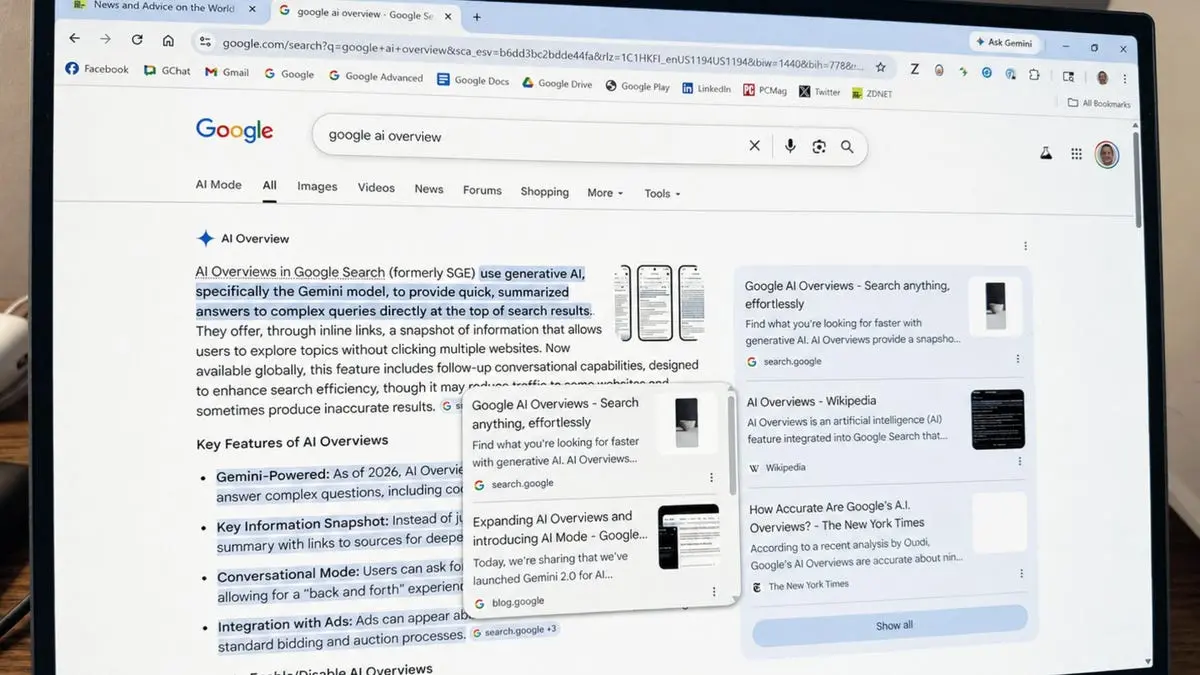
Google's AI Overviews have become a go-to tool for many users seeking quick answers to their search queries. However, the summaries have often been criticized for lacking depth and failing to provide clear, direct access to the sources used to generate them. In response, Google has announced a set of five significant updates to AI Overviews that aim to bridge this gap, making the feature more transparent, trustworthy, and useful for people looking for detailed information and human perspectives.
1. View Advice From Other People
The most notable new feature is the addition of expert advice from real people, drawn from discussion forums, social media, and other online communities. This section, called Expert Advice, appears within the AI Overview and offers brief remarks from individuals who have firsthand knowledge or experience on a given topic. For example, if you search for the best photography settings for the northern lights, the overview might display a snippet from a photography forum discussing optimal exposure times. Each remark includes the name of the person or the forum, along with a clickable link to the full discussion thread. This allows users to explore alternative viewpoints and join conversations if desired.
This feature addresses a long-standing limitation of AI-generated content: the lack of personal, anecdotal experience. While large language models can synthesize factual information, they often miss the nuanced, lived perspectives that make advice truly valuable. By integrating human voices directly into the overview, Google is acknowledging that some of the best answers come from community knowledge. The company has been testing this feature with a variety of topics, from pet care to travel tips, and early results show that users are more likely to engage with the content when they see real people behind the advice.
Google has implemented safeguards to ensure that the cited comments are relevant and from credible sources. The system prioritizes discussions that are active, well-moderated, and have high engagement, although it does not guarantee the factual accuracy of every remark. The company encourages users to click through to the full discussion for more context. This move also helps forum and social media platforms gain more visibility, potentially driving traffic to those sites.
2. Access Your News Subscriptions
Another major update is the ability to surface links to a user's subscribed news sources directly within AI Overviews and AI Mode. Many people have favorite outlets they trust, such as technology news sites or local newspapers. Previously, those sources were not always prominently featured in the overview. Now, Google will highlight subscription-based links, making it easier for users to read full stories. For instance, if you have a subscription to ZDNET, a search about AI trends might show a link labeled with your subscription badge, taking you straight to the in-depth article.
This feature is part of Google's broader effort to support the news ecosystem and encourage subscriptions. The company has provided a Subscription Linking page for publishers to set up the integration. Early tests indicate that users are significantly more likely to click on links that are identified as coming from their subscriptions. This not only improves user experience by providing access to paywalled content without frustrating barriers but also helps publishers retain and grow their subscriber base. For Google, it reinforces the role of AI Overviews as a gateway to quality journalism rather than a replacement for it.
To enable this, publishers must implement Google's subscription linking protocol, which allows the search engine to recognize when a user is a subscriber. The feature works across devices and is automatically enabled for publishers that have already set up this system. Google promises that user privacy is maintained, as subscription status is checked locally without sharing personal data with the search engine. This update is a win-win for readers who want deeper coverage and for publishers seeking to monetize their content in an AI-driven search environment.
3. See Links to the Sources in the Summary
One of the most requested improvements has been better visibility of sources within the AI Overviews. Traditionally, while sources were listed at the bottom of the summary, it was not always clear which part of the overview came from which source. The new update addresses this by placing inline links directly next to the relevant text in the AI summary. For example, if an overview states that a bike ride through California involves varying terrain, a link to a Pacific Coast bike touring guide will appear next to the mention of terrain. Similarly, a bullet point about daily mileage might link to a blog post about bike ride training.
This change is designed to combat the opacity that often surrounds AI-generated content. By making the connection between a statement and its source explicit, Google helps users verify information and explore the original context. It also reduces the risk of misinformation by encouraging users to check primary sources. The inline links are visually distinct, typically appearing as underlined phrases or clickable icons. In tests, users found this feature to be the most helpful for understanding how the AI arrived at its responses.
Google's engineers have developed a new algorithm to match specific claims in the overview with the most relevant sentences from source documents. This is a challenging task because the AI often paraphrases or combines information from multiple sources. The algorithm prioritizes sources that are authoritative and recent, and it attempts to avoid linking to low-quality or irrelevant pages. Over time, Google plans to refine this feature based on user feedback, potentially allowing users to select which sources to prioritize for a given query.
4. Explore Additional Sources
Beyond the direct citations, Google is adding a new section below the AI Overview that suggests additional sources on the same topic. This section is separate from the standard web results and offers a curated list of articles, analyses, or case studies that cover different aspects of the query. For example, if you search for how cities are adding green spaces, the additional sources might include a case study on Seoul's stream restoration project or a report on New York City's High Line park. These suggestions are generated by analyzing the same set of source documents used to create the overview, but they offer alternative angles or deeper dives that the AI summary itself may not highlight.
This feature is meant to counteract the tendency of AI summaries to oversimplify complex topics. By providing a diverse set of additional readings, Google encourages users to explore the subject more thoroughly. The suggestions are dynamic and can change based on the user's location, language, and past search behavior. Google also uses a technique called query fan-out, which performs multiple related searches in parallel to discover a wider range of relevant content. The result is a richer set of options than what would normally appear in the first few search results.
Publishers and content creators stand to benefit from this feature as well, as it increases the chances of their work being discovered even if it does not make it into the primary AI Overview. Google has stated that it will prioritize sources that demonstrate expertise, authority, and trustworthiness, following E-A-T guidelines. The company also plans to add a feedback mechanism for users to indicate whether the suggested sources are helpful, which will help refine the algorithm over time.
5. Preview Linked Websites in the Summary
Finally, Google is introducing a hover preview for links within the AI Overview. When users hover their mouse over a link in the summary, a small popup appears showing the name or title of the website and perhaps a brief description. This allows users to get a sense of where the link will take them before clicking, reducing the uncertainty that often prevents people from exploring external sources. For instance, if the overview includes a link to a blog about bike trip planning, hovering over it might reveal the blog name, such as "Cycle California Adventures." This helps users decide if the link is worth visiting.
The preview is designed to be unobtrusive and fast-loading, using cached metadata from the linked pages. It appears almost instantly and disappears when the user moves the cursor away. Google has tested this feature extensively and found that it increases click-through rates by about 10%, as users feel more confident about following links. The feature is available on desktop browsers and is being optimized for mobile devices, where hovering is replaced by a long-press action.
This update addresses a common complaint about AI Overviews: that they often feel like a black box, with no easy way to verify claims or explore further. By making links more transparent, Google hopes to foster a more open relationship with users and encourage critical thinking. The previews also serve as a gentle nudge to leave the AI environment and explore the web, which aligns with Google's mission to connect people with the best information online.
Background and Impact
Google first introduced AI Overviews in May 2024 as a major shift in search towards generative AI. The feature uses a custom version of the Gemini model to produce summarized answers directly on the search results page. Initially, it faced significant criticism for generating bizarre or inaccurate responses, such as suggesting users eat rocks or glue pizza. Google responded by implementing stricter quality controls, limiting the types of queries that trigger overviews, and adding more human oversight.
These five new updates represent a maturity of the product, showing that Google is listening to user feedback and iterating quickly. The company has also emphasized that these changes are part of a broader strategy to keep the web open and accessible. By linking to human advice and subscription news, Google is acknowledging that AI alone cannot replace the richness of diverse voices and verified journalism. The updates also come at a time when regulators and publishers are scrutinizing AI's impact on traffic and revenue.
For users, the enhancements mean that AI Overviews will become a more useful starting point for research rather than a final destination. The ability to see advice from real people, access subscription content, and verify sources inline should increase trust. However, challenges remain. The Expert Advice feature may still surface misinformation from less reputable forums, and the inline links could be gamed by SEO spammers. Google has stated that it will continuously monitor and adjust its algorithms to maintain quality.
In terms of performance, early data shows a slight increase in overall user engagement with AI Overviews since the rollout began in late April 2026. The features are being gradually released to English-speaking users in the United States, with a global expansion expected later this year. Google has also promised to add more customization options, such as the ability to block certain sources or prioritize others.
Technical Details and Implementation
Under the hood, these features require significant advances in natural language processing and information retrieval. The advice-from-people feature relies on a real-time scoring system that evaluates the relevance and credibility of forum posts. Google has built a dedicated index of discussion forums and social media platforms, which are then cross-referenced with the user's query. The system ranks posts based on factors like upvotes, recency, and the reputation of the author or platform.
The subscription link feature uses Google's existing Subscription Linking API, which allows publishers to authenticate users and serve personalized links. Google ensures that the authentication process is seamless, often using a simple Google sign-in that checks the user's subscription status without exposing sensitive data. The inline source links are generated by a separate model that maps each sentence of the summary to the most relevant sentence in the original article. This model has been trained on a large corpus of Q&A pairs and has shown high accuracy in early evaluations.
The additional sources section is powered by a diversified search algorithm that identifies subtopics and complementary content. It uses a combination of keyword extraction and semantic similarity to find articles that cover angles not fully explored in the summary. Finally, the hover previews rely on a lightweight schema that pre-fetches metadata from linked domains, ensuring speed and privacy. Google has assured that no user data is sent to third-party sites during the preview.
These technical improvements also have implications for web publishers. The inline source links provide explicit attribution, which can improve SEO for content creators who are cited. However, it also means that publishers must ensure their content is well-structured with clear, scannable sections that the AI can easily reference. Google recommends using descriptive headings, bullet points, and concise paragraphs to increase the chance of being featured.
Broader Implications for Search
The updates signal a shift in how Google views the role of AI in search. Instead of trying to answer every query entirely within the search results, the company is now focusing on being a connector between users and the best content available. This is a departure from earlier approaches that aimed for complete self-containment. The Expert Advice feature, in particular, highlights the value of human-generated content and community knowledge, which AI cannot fully replicate.
This move may also help Google address antitrust concerns. Regulators have worried that AI Overviews could reduce traffic to third-party websites, harming competition. By prominently linking to human advice and subscription news, Google can argue that it is still sending valuable traffic to other sites. Early data shows that click-through rates to cited sources have increased since the introduction of inline links.
However, not all feedback has been positive. Some publishers worry that the AI Overviews still cannibalize traffic for simple queries, and that the new features merely redirect users to the same large, dominant platforms. For example, the Expert Advice feature may disproportionately favor Reddit, Quora, and similar sites because they have the most indexed discussion threads. Google has not published data on which types of sites benefit most from these features.
Despite these concerns, the updates represent a step forward in making AI-generated search results more transparent and useful. Users who have tested the features report a higher level of satisfaction and trust. As Google continues to refine AI Overviews, it is likely that these five features will become standard, with even more sophisticated integrations in the future. For now, the company seems committed to balancing the efficiency of AI with the depth of human knowledge, a goal that many in the industry consider essential for the future of search.
Source: ZDNET News