

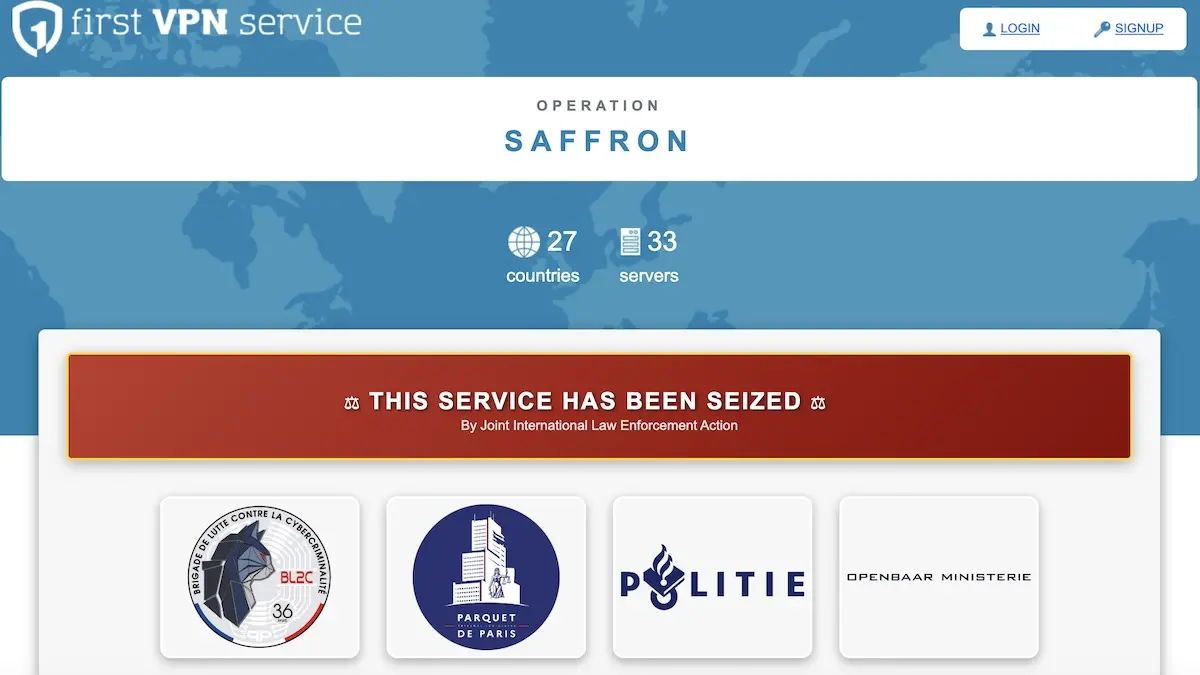
Law enforcement agencies across North America and Europe have successfully disrupted First VPN, a long-running cybercrime service that served as a critical infrastructure component for ransomware operations and other malicious activities. The operation, which involved multiple international partners, led to the arrest of the service's alleged administrator in Ukraine and the dismantling of 33 servers that powered the network.
According to the FBI, First VPN had been operational since 2014, providing a network of 32 exit nodes spread across 27 countries at the time of its takedown. The service was advertised on Russian-language dark web forums, making it a go-to tool for cybercriminals seeking to mask their true locations and identities while conducting network reconnaissance, launching intrusions, and deploying ransomware. The FBI's alert notes that IP addresses associated with First VPN were linked to scanning activities, botnets, distributed denial-of-service (DDoS) attacks, and hacking incidents.
At least 25 ransomware groups were known to have used First VPN's services, highlighting the extent to which such anonymization tools have become a cornerstone of the cybercrime economy. Ransomware operations, in particular, rely on layers of obfuscation to avoid detection and attribution. By providing a stable and trusted VPN infrastructure, First VPN allowed these groups to focus on their attacks rather than on building and maintaining their own concealment systems.
Europol, which coordinated the European aspects of the operation, stated that law enforcement and partners disabled 33 servers linked to First VPN, targeting the domains 1vpns.com, 1vpns.net, 1vpns.org, and associated onion addresses. The takedown effectively severed the service's ability to route traffic for its criminal clientele. In a statement, Europol emphasized that users of the service had been notified of the shutdown and informed that they had been identified. Information on 506 users was shared with authorities in multiple countries, enabling further investigations and potential prosecutions.
Bitdefender, a cybersecurity firm that participated in the takedown, provided additional context. The company pointed out that the 506 users represent only a subset of First VPN's total customer base. Investigators will now work to determine which of these users can be directly linked to specific criminal operations. Some will be traced to known ransomware groups, while others may reveal fraud schemes, data theft campaigns, or previously unknown cybercrime-as-a-service infrastructure. Bitdefender noted: "New anonymization services will appear. The economic demand hasn't changed. But each takedown shortens the operational window of the next service and raises the barrier for actors who relied on turnkey solutions." The firm also highlighted the symbolic significance of the operation: "First VPN advertised itself as a service criminals could trust to keep them beyond law enforcement's reach. The operation proved that claim wrong, and every actor evaluating the next anonymization service now knows the same risk exists."
The disruption of First VPN is part of a broader pattern of international crackdowns on criminal infrastructure. In recent years, similar operations have targeted other VPN and proxy services, such as DoubleVPN and VPNLab.net, which were also dismantled by law enforcement. These takedowns are often conducted under the auspices of the Joint Cybercrime Action Taskforce (J-CAT) and other collaborative initiatives. The FBI has published a detailed alert containing technical indicators of compromise (IoCs), MITRE ATT&CK mappings, and recommendations for organizations to defend against tactics commonly used by First VPN clients.
The criminal use of VPNs is a long-standing challenge for law enforcement. While VPNs have legitimate applications for privacy and security, cybercriminals have long abused them to obscure their activities. First VPN was particularly attractive because it offered a dedicated service for illicit purposes, with a focus on reliability and anonymity. The service promised customers that their traffic would be routed through multiple jurisdictions, making traceability difficult. However, law enforcement's ability to infiltrate and dismantle such services has improved through better intelligence sharing, advanced forensic techniques, and cooperation with private sector cybersecurity firms.
The arrest of the administrator in Ukraine underscores the international dimension of cybercrime investigations. Ukraine has become a key partner for Western law enforcement in combating cybercrime, often arresting individuals involved in ransomware operations, botnet administration, and malicious software development. The suspect now faces potential extradition or prosecution in Ukraine or elsewhere, depending on where the charges are filed.
For the cybersecurity community, the takedown sends a clear message: no service is beyond reach. While new anonymization services will inevitably emerge to fill the void left by First VPN, each enforcement action erodes the trust that cybercriminals place in these tools. The operational costs for criminals increase as they must seek out new providers, vet their reliability, and risk exposure during transitions. Furthermore, the identification of 506 users may lead to a cascade of secondary investigations, potentially uncovering connections between seemingly disparate attacks and revealing the infrastructure behind major ransomware incidents.
Organizations are advised to review their defenses against the types of activities facilitated by First VPN. The FBI's alert provides specific detection guidelines, including monitoring for connections to known First VPN IP ranges, analyzing network traffic for patterns consistent with VPN usage from multiple jurisdictions, and implementing robust logging and response procedures. Additionally, companies should ensure that their incident response plans account for the possibility that attackers may be using multiple layers of anonymization.
The takedown of First VPN is a significant achievement, but it is not a silver bullet. Cybercriminals are resilient, and the demand for anonymization services remains high. However, each successful operation demonstrates that international cooperation and innovative investigative techniques can disrupt even the most entrenched criminal ecosystems. The long-term impact will depend on sustained law enforcement pressure, continued collaboration with the private sector, and a proactive approach to identifying and dismantling the next generation of cybercrime services.
Source: SecurityWeek News