

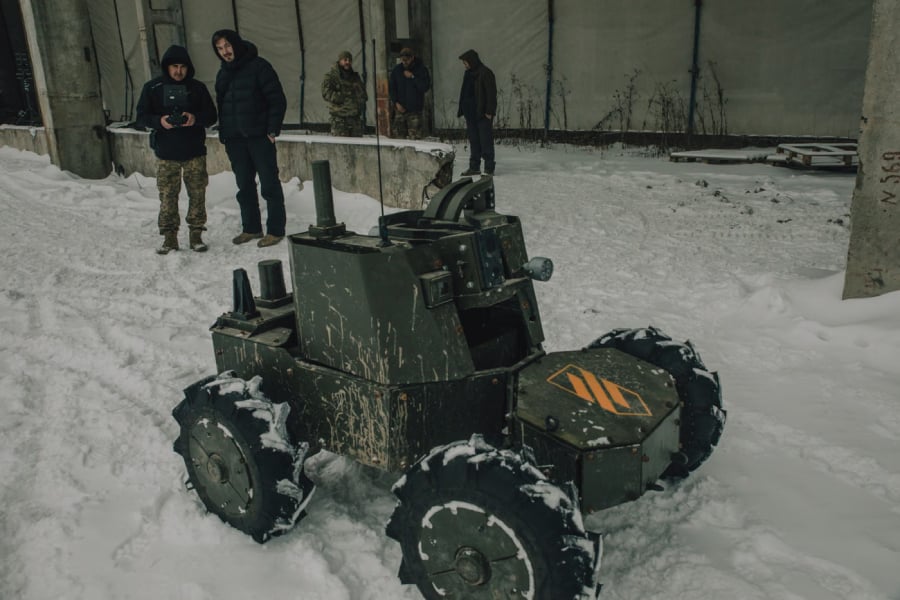
Robots are now a common sight on Ukraine's battlefields, taking on high-risk missions that even trained soldiers hesitate to attempt.
With the war against Russia entering its fifth year, Ukraine is increasingly relying on affordable robotic technologies to minimize human losses and maintain operational efficiency. Since their introduction in 2024, these machines have become integral to Ukraine's strategy of rapid adaptation in the face of Russian aggression.
From delivering supplies to conducting surveillance, and even engaging enemy troops, Ukraine is demonstrating that the future of warfare may involve an increasing reliance on robotic systems rather than human soldiers.
Creativity at the Heart of War
War has historically driven the advancement of technology, and the conflict between Ukraine and Russia is no exception. The ongoing war has fostered developments in various technologies, ranging from drones to improved logistical systems.
Initially characterized by uncertainty due to Russia's military size and budget, the conflict has evolved into a contest for technological dominance. Ukrainian-developed drones have gained a reputation for their accuracy, making them desirable for several countries in the Gulf region. These drones are reported to be capable of intercepting long-range kamikaze drones used by both Tehran and Moscow.
By utilizing unmanned systems, Ukraine not only reduces the risk to its soldiers but also cuts costs through the use of inexpensive, yet effective, robotic technologies.
A Mix of War Machines
Various types of robots are currently deployed in the conflict. Some function as drones for logistics, while others deliver precision-guided munitions or engage in combat operations. Notably, Unmanned Ground Vehicles (UGVs) are now responsible for 90% of logistical operations within the Ukrainian military, with over 7,000 UGV missions recorded in January alone.
Lieutenant Victor Pavlov of the Ukrainian 3rd Army Corps explained the pivotal role of UGVs in logistics: “It’s very difficult to move around because of enemy first-person-view drones. So we use robotic systems.”
Among the success stories is a DevDroid TW 12.7, which effectively defended a Ukrainian position for 45 days. Another robot traveled 20 kilometers to destroy a building occupied by Russian troops using explosives it had transported.
These machines have proven their resilience in dangerous situations, performing daring rescue operations and even assisting in construction tasks like laying barbed wire.
The Advantage of Size and Cost
Despite losing about 25% of their robotic units to Russian forces, Pavlov asserts that the cost-effectiveness of these machines justifies the losses. The affordable materials used for production enable Ukraine to mass-produce drones and robots. Furthermore, their smaller size allows them to evade detection by enemy drones, giving them a tactical advantage.
Additionally, the operational endurance of these machines, averaging eight hours, often surpasses that of human soldiers, further enhancing their effectiveness in the field.
Limitations of a Machine This Lethal
While these robotic systems offer significant advantages, they also face limitations, many of which stem from ethical considerations. According to a deputy commander, most unmanned machines remain under human control, with operators making the final decision to engage targets.
Known by the callsign Afghan, the deputy commander remarked, “Modern UGVs are part-autonomous. They can move and detect enemies on their own. However, the decision to open fire must be made by a human operator.” He emphasized the importance of human oversight to prevent misidentifications and potential harm to civilians.
A New Kind of War
Russia continues to develop its own robotic capabilities, deploying machines like Courier, an electric vehicle designed for electronic warfare and capable of carrying substantial loads. Furthermore, Russian forces are creating the Kuryer UGV, which can be equipped with weaponry such as flamethrowers and machine guns.
The evolution of robotic warfare highlights the shifting landscape of modern conflict. The U.S. is also investing heavily in AI for military applications, indicating that future warfare may heavily feature automation.
However, concerns persist regarding the safety and ethical implications of using robotic systems in combat. While Ukraine appears to be implementing ethical guidelines in their use of these machines, the rapid growth of unmanned technologies raises questions about potential misuse without proper international regulations.
Also read: China’s robotic innovations showcase the expanding role of robotics beyond military applications into civilian sectors.
Source: eWEEK News